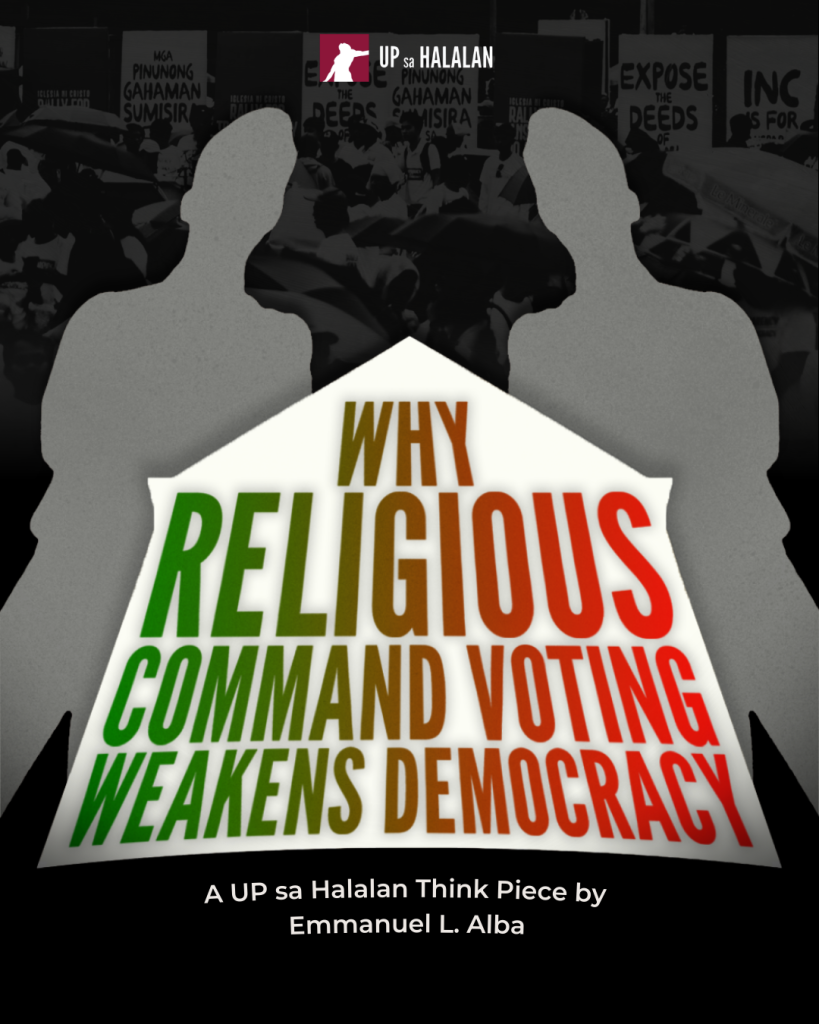
On November 16, 2025, members of the Iglesia ni Cristo (INC) gathered at the Quirino Grandstand for what was planned as a three-day rally calling for “Transparency for a Better Democracy,” but the event was cut short and ended on the second day. As one of the country’s most politically influential religious organizations, the INC is widely known for bloc or “command voting,” where members are instructed to “vote as one” based on decisions made by church leadership. This collective voting power has earned the group a reputation as a “kingmaker,” influencing electoral outcomes and securing access to political elites. In 2022, its endorsement for the UniTeam coalition helped consolidate the landslide victory that brought Bongbong Marcos Jr. and Sara Duterte to power. But the political landscape the INC helped construct has since fractured, placing the group in the middle of the Marcos-Duterte split.
In January 2025, the INC mobilized what it called a “National Rally for Peace,” drawing an estimated 1.5 million participants to oppose the impeachment efforts against Vice President Duterte. Though aligned with the administration’s position, the event provoked backlash. The late Juan Ponce Enrile warned that such mass religious mobilization set a “detrimental precedent,” a concern Marcos Jr. echoed when he described the precedent as “problematic,” even as he opposed impeachment.
The group’s latest rally centers on allegations of massive corruption in flood-control projects. Yet the event carries a subtle irony: the same bloc voting that now empowers the INC to demand transparency helped deliver into office many of the political leaders under whom these alleged irregularities occurred. By shaping electoral outcomes through command voting, the group helped consolidate the very political power it now challenges. This paradox exposes a deeper structural issue: bloc voting concentrates influence in leaders, redirects accountability away from individual citizens, fosters patronage, and constrains policy competition—making it a symptom of democratic fragility rather than a remedy.
Religious endorsements undermine electoral accountability
A central problem with bloc voting is that it weakens individual electoral accountability. When religious organizations command members to “vote as one,” politicians become more responsive to church leadership than to the broader electorate. Mahar Mangahas has noted that INC’s command voting remains a prized endorsement, especially in close races. Endorsements like those for the 2022 UniTeam coalition demonstrate how candidates prioritize courting INC leaders, shifting the balance of accountability away from citizens.
INC is not alone. The Catholic charismatic movement El Shaddai publicly endorsed senatorial candidates in 2019 and later supported Marcos–Duterte in 2022. The Jesus Is Lord (JIL) Church has endorsed multiple senatorial candidates, often aligned with its own party-list, CIBAC.
While framed as moral guidance or civic participation, bloc voting concentrates political influence in a few leaders, reducing politicians’ incentives to appeal to the wider public. It also fosters transactional politics, in which favors, appointments, or resources are exchanged for organizational support. This makes bloc voting less a form of active civic engagement than a structural mechanism that redirects accountability, constrains deliberation, and amplifies the political weight of a few over the many. Religious engagement is not inherently harmful, but when centralized authority dictates political choice, it weakens democratic responsiveness.
Fragility and volatility
Bloc voting does more than elevate religious leaders’ influence—it reshapes electoral competition. When a religious group shifts its support, it can dramatically alter election outcomes and pressure politicians to adjust their positions, producing a fragile political environment. Even the perception of a change in endorsement can influence campaign strategy, revealing how concentrated bloc power injects uncertainty into electoral dynamics.
This pattern extends beyond the Philippines. In Poland, the Catholic Church’s ability to mobilize voters has periodically swung elections toward conservative parties, shaping national policy and political stability. In India, endorsements by influential religious organizations have significantly affected tightly contested state and national elections. By contrast, the United States presents a more diffuse model: research by the Cultural Research Center at Arizona Christian University shows that evangelicals influence elections primarily through high turnout, issue alignment, and informal pastoral guidance—not centralized command voting. Together, these cases illustrate different modes of religious political engagement, but they underscore a shared risk in contexts like Poland, India, and the Philippines: when electoral outcomes hinge on the directives of powerful gatekeepers, democratic resilience erodes and politics becomes more vulnerable to abrupt, organization-driven shifts.
The long-term consequences are equally concerning. When political success depends on courting gatekeepers rather than voters, parties may prioritize short-term compliance over substantive policy innovation. This creates a feedback loop where organizations gain disproportionate leverage, politicians avoid unpopular reforms, and public deliberation narrows. In contexts like the Philippines, such dynamics risk embedding volatility into the democratic system itself, making institutions more reactive to elite bargaining than to societal needs.
Counterpoint and nuance
Yet bloc voting is only one mode of religious political activity. Faith-based organizations can also play positive democratic roles when they respect internal pluralism and uphold civic norms. The Church of Jesus Christ of Latter-day Saints (LDS), for example, emphasizes voter participation and civic education without endorsing specific candidates, encouraging involvement without coercion. This shows that religious mobilization need not undermine democracy; its democratic impact depends on whether it promotes informed, autonomous participation or reinforces centralized control.
The broader institutional environment also matters. Religious groups contribute most effectively to democratic life when their internal governance allows debate, dissent, and accountability, and when political institutions reward responsiveness to citizens rather than gatekeepers. Without these conditions, even well-intentioned mobilization can inadvertently strengthen patronage networks or amplify elite influence. Comparative experiences suggest that embedding pluralism and civic education within religious communities can transform their mobilizing power into a force for deepening—not destabilizing—democratic participation.
Policy implications and recommendations
Addressing the risks of bloc voting requires both institutional and cultural reforms. Strengthening party platforms and candidate accountability can reduce the reliance on religious endorsements as shortcuts to electoral success. But reforms must also confront a deeper danger: bloc voting entrenches institutionalized patronage between organizational leaders and politicians, creating informal channels of influence that persist beyond electoral cycles. Even if the promises exchanged for bloc support remain hidden, transparency can be improved by monitoring campaign spending, outreach events, and the mobilization roles of organizations—helping citizens understand where political leverage is exercised.
Civic education should promote individual voting autonomy and the long-term costs of transactional politics. Religious organizations themselves can contribute by emphasizing issue-based voter education rather than explicit endorsements, encouraging informed participation while respecting ethical boundaries between faith and political power. Together, these reforms can help ensure that concentrated influence does not solidify into enduring patronage networks.
Rethinking influence and accountability
The rally at the Quirino Grandstand illustrates not only INC’s organizational power but also the fragility of democratic processes when influence is concentrated in the hands of a few. Bloc voting, while projecting unity, paradoxically weakens accountability and deliberation—the core ingredients of democratic decision-making. It also makes the organization vulnerable to being used as a political platform by actors seeking to leverage its mobilizing capacity for their own agendas. The spectacle of thousands calling for “transparency” thus underscores a central irony: mobilization without individual choice risks reinforcing the very hierarchies that enable corruption, patronage, and instrumentalization by political elites to persist.
True democratic reform cannot be achieved by amplifying organizational power alone. If the INC and other faith-based institutions genuinely seek better governance, they must cultivate internal pluralism and promote informed, autonomous voting. Their commitment to democracy will ultimately be measured by whether they can make space for a principle that their practice of bloc voting has long constrained: the free, and accountable decision of each member especially during elections.
Emmanuel L. Alba is Teaching Associate at the Department of Political Science, University of the Philippines Diliman. All views here are the author’s own.


